Simplified GST Registration System – Legal Analysis of Notification Effective 1st November 2025
Home Blogs





1. Background & Objective of Reform
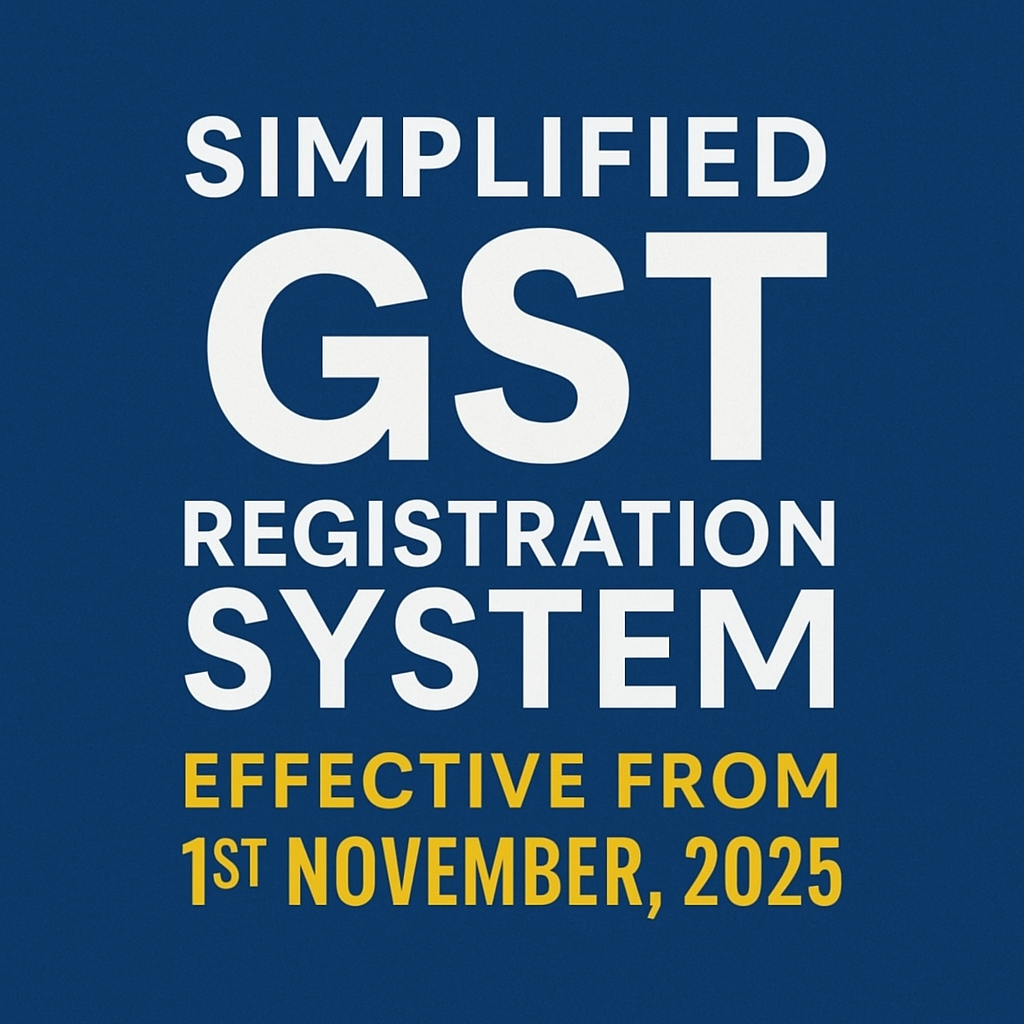
The Central Board of Indirect Taxes and Customs (CBIC) has notified a Simplified GST Registration System effective 1 November 2025, pursuant to the recommendations of the GST Council in its 55th Meeting held on 20 September 2025.
This reform forms part of the “GST 2.0 Re-engineering Initiative” aimed at enhancing Ease of Doing Business (EoDB)and ensuring risk-based, technology-driven compliance for low-risk taxpayers.
The amendment primarily targets small and low-risk businesses, introducing an automated, time-bound registration mechanism under newly inserted Rule 9A and Rule 14A of the Central Goods and Services Tax Rules, 2017.
2. Statutory Basis and Notification Reference
The legal foundation for the reform is provided through:
Notification / Circular | Particulars | Effective Date |
Notification No. 54/2025 – Central Tax, dated 01-10-2025 | Insertion of Rule 9A (Simplified Registration for Low-Risk Taxpayers) and Rule 14A (Risk-based Automatic Approval) in the CGST Rules, 2017 | 01-11-2025 |
Circular No. 193/15/2025-GST, dated 03-10-2025 | Clarifies eligibility criteria, system-driven approval process, and verification methodology | 01-11-2025 |
Section 25(1) read with Section 164 of the CGST Act, 2017 | Empowering provisions for registration and rule-making | Already in force |
3. Summary of the New Framework
3.1 New Rule 9A – Simplified Registration Process
3.2 New Rule 14A – Risk-Based Approval Workflow
4. Eligibility Criteria (per Circular 193/15/2025-GST)
Parameter | Eligibility Condition |
Turnover Threshold | Aggregate turnover in the preceding financial year not exceeding ₹1.5 Crore (for goods) / ₹75 Lakh (for services) |
Monthly Output Tax Liability (B2B) | Expected to remain below ₹2.5 Lakh |
Risk Rating | System-assessed as “Low Risk” on basis of analytics |
Constitution | Proprietorship, Partnership, LLP, Private Limited Company or OPC |
Geographical Limit | Business premises within India and verifiable through geo-tagged KYC |
No past default | Applicant (or related PAN entities) should not have past cancellation / ITC fraud proceedings |
5. Procedural Flow – Step-by-Step under New Regime
6. Interaction with Other Provisions
Linked Rule/Section | Impact / Interpretation |
Section 25(1) | Registration continues to be mandatory for taxable persons exceeding threshold limits. Simplified route changes only procedure, not liability. |
Rule 8(4A) | Aadhaar authentication remains compulsory. |
Rule 9(2) | Applies where system flags moderate/high risk; officer retains discretion. |
Rule 25 | Physical verification limited to risk-based exceptions. |
Rule 21(b) | False declaration of eligibility under Rule 9A can lead to cancellation. |
7. Legal and Practical Implications
By embedding risk analytics, human discretion during initial registration is curtailed — aligning with Article 14’s principle of equality before law.
Auto-approval within a fixed timeframe creates a statutory right akin to “deemed registration”, minimizing administrative delay.
The interplay of Rules 8(4A) and 9A strengthens legal validation of identity — reducing cases of “fly-by-night” registrations.
The structured, algorithmic approval process minimizes potential litigation on arbitrary delays, satisfying natural justice and proportionality principles.
Every system-approved registration leaves a digital audit trail; falsification or misrepresentation can trigger Rule 21(b) cancellation and potential Section 122(1)(xii) penalties.
8. Transitional Provisions
9. Advisory Note for Businesses & Professionals
“On the basis of the advice of D K Tax Consultants,”
every business intending to register post 01-11-2025 should:
10. Conclusion
The Simplified GST Registration System, notified via Notification No. 54/2025 – Central Tax, represents a decisive step toward data-driven governance and reduced compliance friction. While it streamlines entry into the GST ecosystem, it simultaneously places greater responsibility on taxpayers to maintain integrity and transparency of data.
As professionals, we must guide clients through eligibility assessment, documentation precision, and risk-profiling so that the intended benefit—faster, legally compliant registration within three working days—is actually realized.
The information contained in this article/poster is intended solely for general informational and educational purposes. It is based on the relevant provisions of the CGST Act, 2017, the CGST Rules, 2017, and related notifications, circulars, and press releases as applicable on the date of publication. While every effort has been made to ensure accuracy, completeness, and reliability of the information, D K Tax Consultants, its partners, or authors accept no liability for any errors or omissions. Readers are advised to seek professional advice before acting upon any information contained herein. The interpretations and opinions expressed are based on the professional understanding of D K Tax Consultants and do not constitute legal opinion. Any reliance placed on such information shall be strictly at the reader’s own risk.